
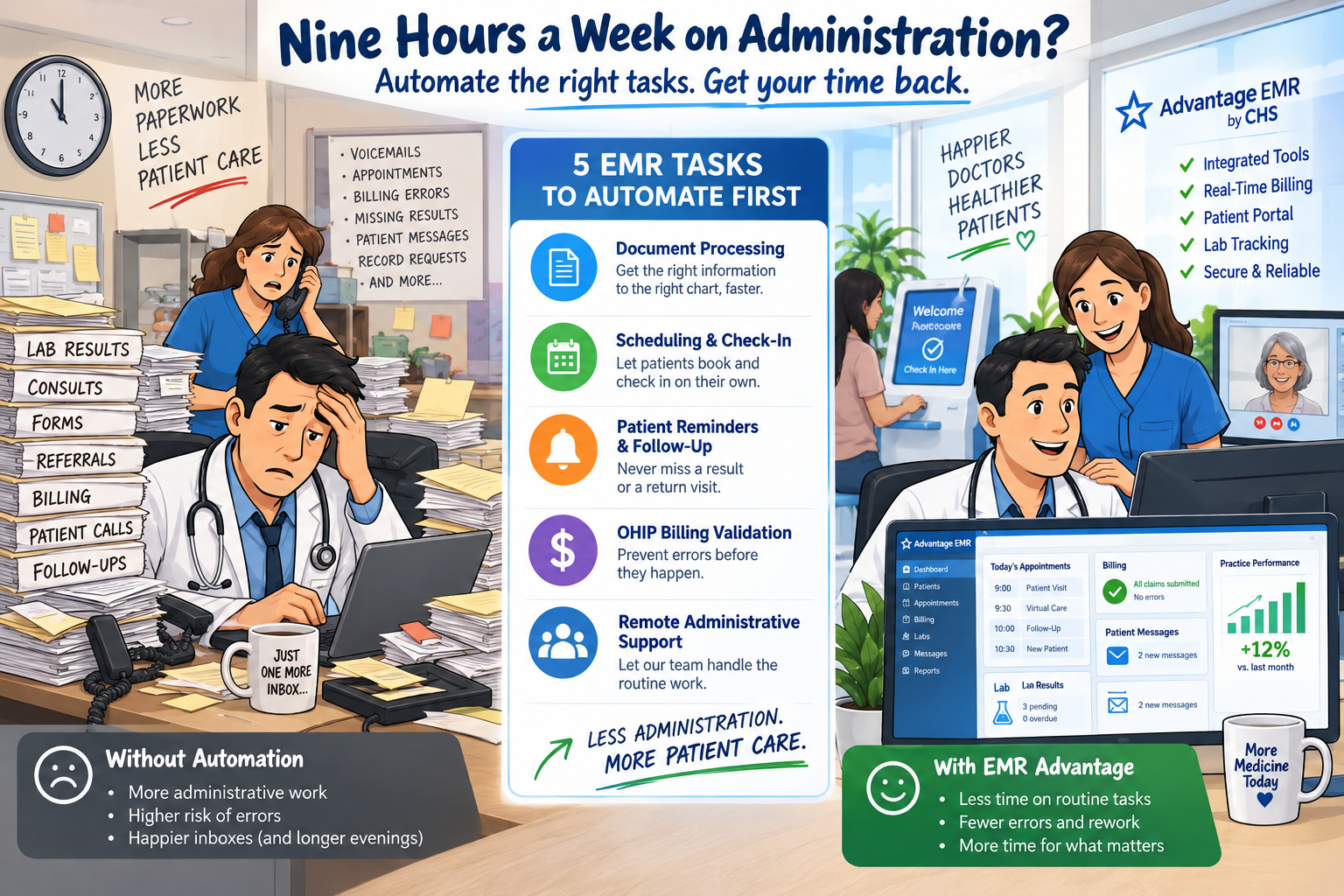
Canadian physicians did not choose medicine because they wanted to spend their evenings clearing inboxes, correcting claims or tracking down missing paperwork.
But that is increasingly part of the job.
According to the Canadian Medical Association and Canadian Federation of Independent Business, Canadian physicians spend an average of approximately 9.1 hours every week on administrative tasks. Across the country, that represents approximately 42.7 million hours annually, with nearly half of that administrative time considered unnecessary work that could potentially be delegated or eliminated.
The problem is particularly significant in Ontario. Physicians in Ontario spend an estimated 10.7 hours per week on administrative work, representing more than 17 million hours annually. Approximately 7.9 million of those hours are considered unnecessary.
That is not simply an inconvenience or a technology problem.
It is a clinical-capacity problem, a physician-wellness problem and, ultimately, a patient-access problem.
The good news is that medical clinics do not need to automate everything to make a meaningful difference.
They need to automate the right things first.
How Should a Medical Clinic Decide What to Automate?
At Canadian Health Systems, we think about administrative automation using four factors:
- Volume: How often is the task performed?
- Repetition: Does it follow the same steps most of the time?
- Consequence: What happens if it is delayed, missed or performed incorrectly?
- Judgment: Does it require clinical reasoning or a sensitive human interaction?
The best early candidates for EMR automation are high-volume, repetitive tasks with clear rules.
When a task requires professional judgment, technology should organize the work and surface the exception—not make the clinical decision.
This distinction matters.
A good EMR should not try to replace the physician, nurse, pharmacist, nurse practitioner or medical office assistant.
It should prevent skilled people from spending their day performing work that software can reliably prepare, validate, route or complete.
For most clinics, the following five areas offer the strongest place to begin.
1. Automate the Document Queue Before It Becomes an Inbox Problem
Every medical clinic receives a constant flow of information:
- Consultation notes
- Hospital reports
- Laboratory results
- Diagnostic imaging
- Referrals
- Forms
- Prescription requests
- Records from other healthcare providers
The burden is not merely receiving those documents.
Someone must match each document to the correct patient, determine what type of document it is, place it in the appropriate part of the chart, route it to the correct person or queue, identify anything requiring timely attention, and maintain a clear audit trail.
When that workflow relies on a general inbox, repeated printing and scanning or several disconnected tools, the clinic pays twice: first in staff time and again when a delayed or misdirected document creates additional work.
This is also where the word automation can be misleading.
Not every incoming document is clean or predictable enough for software to process without oversight. A better model combines technology with trained people who manage exceptions.
CHS offers document handling and processing alongside EMR Advantage®. Our administrative support team processes and uploads documents seven days a week, including after hours.
That allows a clinic’s local team to concentrate on patient-facing and clinical work rather than beginning each morning with an accumulated document backlog.
The objective isn’t to make documents disappear.
It is to ensure that the right information reaches the right person, in the right chart, at the right time—with less manual handling along the way.
What should clinics measure?
Document turnaround time, documents waiting at the beginning and end of each day, rework caused by incorrectly filed documents, and physician time spent triaging clerical material.
2. Automate Patient Scheduling and Check-In
Scheduling appears simple until a clinic tries to coordinate multiple providers, appointment types, locations, in-person visits, virtual visits, urgent requests and last-minute changes.
In a traditional workflow, even a routine appointment may require multiple administrative steps:
- The patient calls the clinic.
- A staff member answers or returns the call.
- The patient and staff member negotiate an appointment time.
- The appointment is entered into the EMR.
- Demographic and health-card information is confirmed.
- Instructions are provided.
- Some of the same information may be collected again when the patient arrives.
Many of those steps do not require staff intervention when the rules are clearly defined.
EMR Advantage includes patient-portal booking and integrated scheduling for both in-person and virtual care. Instead of operating separate calendars or third-party virtual-care schedules, clinics can manage these appointment streams as part of the same platform.
When the patient arrives, the EMR Advantage self-registration kiosk can allow patients to check in and update information including telephone numbers, email addresses and health-card information.
That reduces repetitive front-desk data entry and allows patients to enter private information directly rather than announcing it in a waiting room.
Automation should never eliminate every route to a person.
Some patients require accessibility support, language assistance or help navigating a complex healthcare need.
The goal is to move predictable transactions to self-service, freeing staff to help the patients who genuinely need human assistance.
What should clinics measure?
Incoming scheduling calls, abandoned calls, average check-in time, demographic corrections, online-booking adoption and staff time spent per appointment.
3. Automate Patient Reminders—and the Follow-Up Behind Them
Appointment reminders are useful.
But reminders alone are not a complete patient follow-up strategy.
A modern EMR should help a clinic answer more important questions:
- Did the patient attend the appointment?
- Was an ordered test completed?
- Did the expected result arrive?
- Did a patient who was asked to return actually come back?
- Is a preventive or chronic-care activity now due?
These are difficult processes to manage with sticky notes, spreadsheets or an employee’s memory.
They are also exactly the kind of time-sensitive, rules-based activities that technology can support well.
EMR Advantage includes automated patient notifications and follow-up capabilities.
It can also track selected laboratory orders and notify the clinician when an expected result has not been received. If a patient has been recalled but does not return as planned, the system can bring that exception back to the appropriate user’s attention.
That changes the workflow from passive inbox management to active exception management.
Staff and clinicians do not have to repeatedly check every normal process. Instead, they can concentrate on the smaller number of items that did not proceed as expected.
This illustrates an important principle in healthcare automation:
Sometimes the most valuable alert isn’t that something happened. It’s that something expected did not happen.
What should clinics measure?
No-show rates, uncompleted recalls, overdue expected results, time spent maintaining manual reminder lists and the age of unresolved follow-up tasks.
4. Prevent OHIP Billing Errors Before They Become Billing Rework
Billing is frequently treated as a back-office activity performed after the patient encounter.
That creates a costly delay between the moment information is available and the moment an error is discovered.
If an invalid health-card version code, missing field or incompatible claim detail is discovered days or weeks later, someone may have to reopen the encounter, determine what happened, contact the physician or patient if necessary, correct the information and resubmit the claim.
A better approach is to validate as much information as possible at the point of care.
EMR Advantage supports:
- Real-time health-card validation
- Integrated billing rules
- OHIP pre-adjudication support
- Real-time claim submission and reconciliation
- Support for bundled codes
- Practice and provider reporting
These functions do not make clinical or professional billing decisions for the physician.
They help identify potentially correctable issues while the encounter is still current and the relevant information is readily available.
From a technology perspective, that represents an important change in philosophy.
Instead of creating a more efficient process for correcting billing errors, the EMR should help prevent avoidable errors from entering the process in the first place.
The result can be less billing cleanup, faster resolution of rejected claims and better visibility into the financial operation of the practice.
What should clinics measure?
Claim rejection rate, time from service to submission, time spent correcting claims, unresolved billing exceptions and the difference between services delivered and revenue collected.
5. Use Remote Administrative Teams for Work Automation Cannot Finish
Software is very good at consistently applying defined rules.
Medical clinics, however, encounter ambiguity every day.
A caller may not know what type of appointment they need.
A document may arrive without enough information to match it confidently.
A referral may require follow-up with another office.
A patient may need reassurance rather than an automated notification.
Those aren’t failures of automation.
They are reminders that healthcare remains a human service.
The most effective clinic operating model uses three layers:
- Self-service for straightforward patient transactions.
- Automation for predictable validation, routing and reminders.
- Trained people for judgment, exceptions and human conversation.
CHS’s administrative and remote staffing services extend this model beyond the software.
Our teams provide call handling, document handling and management reporting services, helping clinics absorb fluctuating administrative workloads without placing every task back onto physicians or on-site staff.
Because these services are designed around healthcare operations and the CHS technology environment, they can complement workflows inside EMR Advantage rather than becoming another disconnected vendor or inbox for the clinic to manage.
The objective isn’t simply to move work somewhere else.
It is to assign each type of work to the lowest-cost, most reliable resource capable of completing it safely: the patient, the software, an administrative team member or the clinician.
What should clinics measure?
Call-answering performance, document backlog, work completed after hours, escalation volume, staff overtime and the percentage of administrative tasks that ultimately return to a clinician.
What About AI and Clinical Documentation?
Clinical documentation is one of the most visible sources of after-hours EMR work.
It also requires more care than routine administrative workflows because the clinician remains accountable for the final medical record.
EMR Advantage allows practitioners to document in the way that best fits their practice, including typing, templates, macros, a stylus, photographs, built-in speech-to-text and supported AI-assisted workflows.
The important question isn’t simply whether a clinic uses AI, dictation or templates.
It is:
Does the technology actually reduce work without creating another correction, privacy or review burden?
Documentation technology should help prepare a better first draft, reduce repeated data entry and make relevant information easier to reuse.
The practitioner must still review the record and confirm that it accurately reflects the patient encounter.
We’ll examine AI-assisted clinical documentation in greater detail in a future Tech Tuesday article.
Don’t Automate a Broken Workflow
Adding technology to a poorly designed process can simply make the wrong process run faster.
Before switching on new automation, a clinic should document what actually happens today—not what the policy manual says is supposed to happen.
Look for:
- Duplicate data entry
- Unnecessary approvals
- Ambiguous ownership
- Manual handoffs
- Disconnected applications
- Places where work repeatedly returns to an earlier step
Then begin with one workflow and establish a baseline.
A practical first-month approach is:
- Week 1: Measure the current volume, time and backlog.
- Week 2: Remove unnecessary steps and define who owns each exception.
- Week 3: Configure and pilot the automated workflow with a small group.
- Week 4: Compare the results, collect staff feedback and adjust before expanding it.
Automation should produce a measurable operational result.
If the clinic cannot identify what improved—time, accuracy, turnaround, revenue capture, patient access or staff workload—it has added a feature, not necessarily solved a problem.
How Can an EMR Reduce Physician Administrative Burden?
An EMR can reduce administrative burden when it does more than simply store patient records.
A modern EMR should:
- Capture information once and safely reuse it
- Allow patients to complete appropriate self-service tasks
- Validate information while it is still actionable
- Route routine work without repeated human handling
- Identify exceptions and missing expected events
- Support staff working from different locations
- Provide clinic leaders with clear operational reporting
- Keep clinical judgment and accountability with the regulated healthcare professional
This is the philosophy behind EMR Advantage.
Canadian Health Systems originated as the research and development division of Appletree Medical Group.
The Advantage platform continues to be shaped by the realities of operating medical clinics—not simply by a list of requested software features.
When physicians, nurses and administrative staff use a system in real clinical environments, an unnecessary click, missing result or cumbersome billing process becomes an operational problem that needs to be solved.
That continuous feedback loop is one of the most important differences between software that merely records work and software that actively helps a clinic operate.
Does EMR Automation Also Benefit Pharmacist-Led and Multidisciplinary Clinics?
Yes. The same automation principles apply to pharmacist-led clinics, nurse practitioner clinics and multidisciplinary healthcare practices.
Although individual clinical workflows and billing requirements may differ, these clinics still manage many of the same operational challenges:
- Patient scheduling
- Registration
- Document management
- Recalls and follow-up
- Laboratory results
- Patient communication
- Clinical documentation
- Administrative reporting
The principle remains the same: automate predictable administrative transactions, route exceptions appropriately and preserve professional judgment for the healthcare professional.
For multidisciplinary clinics, a shared technology platform can also reduce the fragmentation that occurs when different providers rely on separate scheduling, communication and documentation systems.
Frequently Asked Questions About EMR Automation
Which clinic task should be automated first?
Start with a high-volume, repetitive task that follows clear rules and has a measurable baseline.
For many clinics, incoming document handling, patient scheduling or billing validation can provide an early and visible return.
The right starting point depends on where the clinic currently experiences its greatest backlog, highest administrative cost or most frequent rework.
Can EMR automation replace clinic staff?
That should not be the primary objective.
Automation is most valuable when it removes repetitive transactions and gives staff more time for patient support, complex coordination and exception handling.
It can also allow a growing clinic to manage more activity without increasing administrative workload at the same rate.
Can an EMR automate patient follow-up?
An EMR can automate reminders, create recall tasks and identify certain missing expected events, such as a laboratory result that has not arrived.
Clinical interpretation and decisions about patient care should remain with the appropriate regulated healthcare professional.
Can an EMR reduce physician paperwork?
Yes, but simply moving a paper process onto a computer does not necessarily reduce administrative work.
An effective EMR should reduce duplicate entry, automate predictable tasks, identify exceptions, support patient self-service and make information easier to find and act upon.
How can an EMR help reduce OHIP billing administration?
An EMR can validate information earlier in the workflow, identify certain billing issues before submission, submit claims electronically, assist with reconciliation and provide reporting that helps clinics identify unresolved billing exceptions.
The objective should be to prevent avoidable billing rework rather than merely process corrections more efficiently.
How should a clinic measure the return on EMR automation?
Measure operational outcomes rather than the number of features enabled.
Useful indicators include:
- After-hours EMR time
- Document turnaround
- Telephone call volume
- Patient check-in time
- No-show rates
- Unresolved follow-ups
- Billing rejections
- Staff overtime
- Administrative cost per patient encounter
- Clinician time returned to patient care
The Best EMR Automation Gives Time Back
More than ten hours of weekly administrative work for the average Ontario physician will not disappear because a clinic purchases one new feature.
Meaningful improvement comes from redesigning the flow of work across the entire practice.
Patients complete the tasks they can.
Software handles predictable rules.
Trained administrative teams resolve exceptions.
Clinicians focus on decisions that genuinely require their expertise.
That is what a modern EMR should do.
It should not merely digitize the administrative burden. It should help remove it.
Want to see how EMR Advantage combines scheduling, patient self-service, reminders, billing automation, document workflows and remote administrative support?
See for yourself how automation saves time and makes practice more enjoyable