
When evaluating an EMR, most clinics focus on the monthly license fee.
It's understandable. Pricing is visible, easy to compare, and often the first question physicians ask.
But focusing only on the monthly fee is one of the most expensive mistakes a clinic makes.
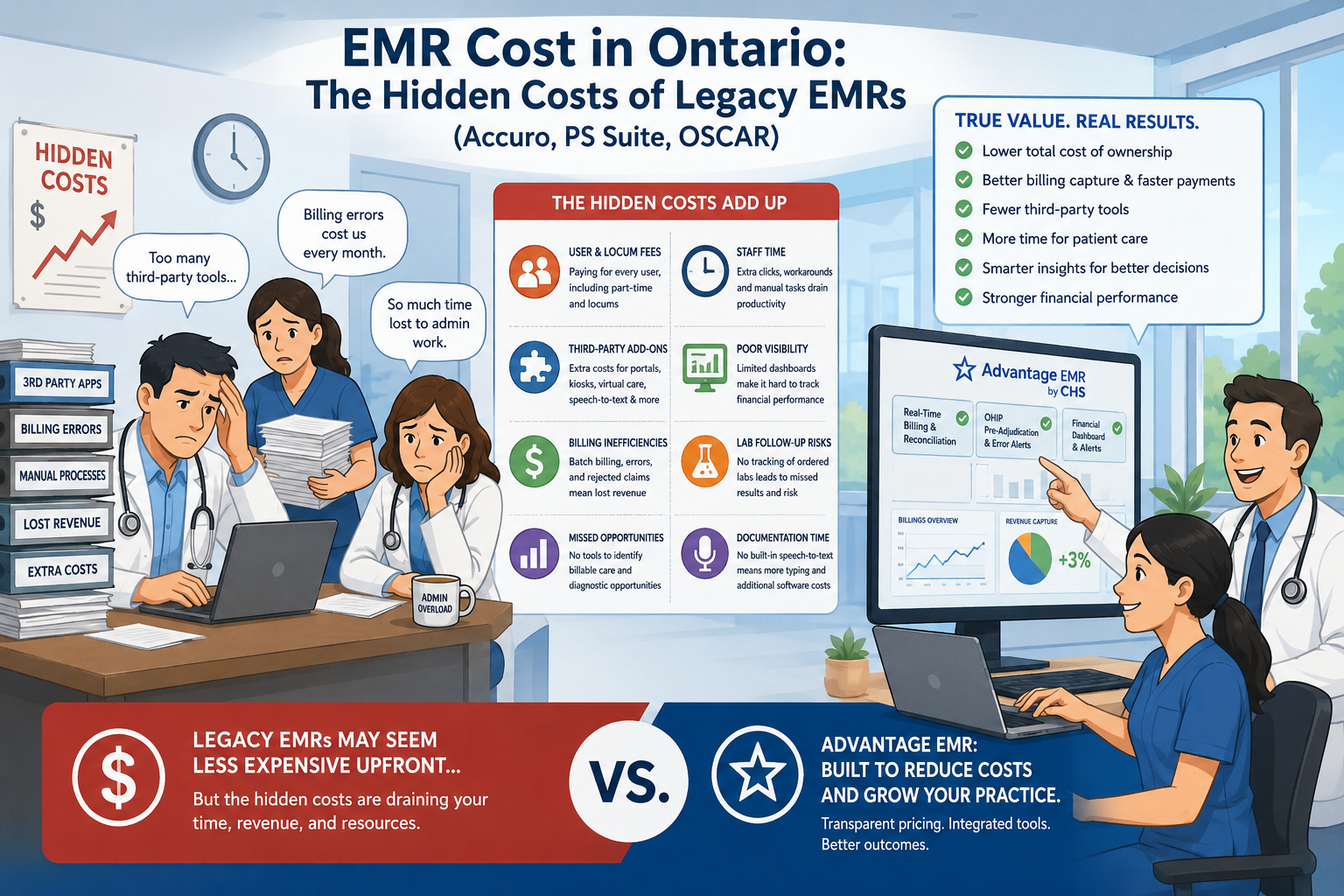
The reality is that the true cost of an EMR extends far beyond licensing fees. The biggest expenses often come from how the EMR is architected: lost productivity, missed billings, third-party software requirements, inefficient workflows, and administrative burden.
Your EMR is going to operate your business, your clinic and your practice. Choosing an EMR is the equivalent of choosing your income and choosing your overhead, all in one. That is why vendors always try to lead with 'features and functions' and avoid higher level discussion such as 'what will this do to my administrative and staffing costs?', 'How much time will your system save compared to the others?' or even the most obvious: 'How can your EMR improve my income and Quality of Care?'
For many Ontario clinics, these hidden costs and lost opportunities built into the legacy systems can amount to tens of thousands of dollars lost and/or spent annually.
Before choosing your next EMR—or deciding whether to stay with your current one—it's worth looking at the full picture.
The Cost You See vs. The Cost You Don't
Most EMR vendors highlight their monthly license pricing.
What they don't always highlight are the inevitable costs associated with:
- Additional users and locums
- Third-party integrations
- Billing inefficiencies
- Lost revenue opportunities
- Staff training
- Administrative overhead
- Multiple ongoing cost streams
- Physician time
The result is that two EMRs with similar monthly fees can have dramatically different total costs of ownership.
Hidden Cost #1: Paying for Every User
Many clinics rely on part-time physicians, nurse practitioners, residents, locums, and temporary staff.
Some EMR platforms charge licensing fees for every practitioner and user, regardless of how frequently they use the system.
At first glance these costs may appear manageable, but they can add up quickly as a clinic grows or if staff or physicians turn over.
Before selecting an EMR, clinic owners should ask:
- Are part-time providers billed differently?
- Are locums included?
- Are administrative staff licensed separately?
- Are there additional fees for temporary users?
The answers can significantly impact long-term costs.
Hidden Cost #2: Third-Party Add-Ons
Many clinics discover that core functionality is sold as additional software.
Examples include:
- Virtual care platforms
- Patient portals
- Patient kiosks
- Speech-to-text software
- Billing tools
- Reporting solutions
While each add-on may seem inexpensive individually, the combined costs can become substantial.
More importantly, in many systems an additional platform introduces:
- Another contract
- Another support relationship
- Another login
- Another training requirement
Integrated systems significantly reduce both costs and complexity.
Hidden Cost #3: Lost Revenue from Billing Inefficiencies
This is one of the most overlooked expenses in healthcare technology.
Many EMRs still rely primarily on batch billing processes.
When billing errors occur, clinics may not discover them until days or weeks later.
Common issues include:
- Invalid health card version codes
- Missing information
- Incorrect billing codes
- Submission errors
Every rejected claim represents delayed or lost revenue.
Modern billing systems that provide real-time feedback and pre-adjudication support can help identify issues before claims are submitted, improving collection rates and reducing administrative effort.
For some clinics, improving billing accuracy at point of care and identifying and preventing rejected claims before they are sent in represents a meaningful increase in annual revenue.
Hidden Cost #4: The Cost of Missed Clinical Opportunities
Most EMRs function primarily as documentation systems.
They store information well but provide limited assistance in identifying clinical opportunities.
As a result, physicians may miss:
- Billable preventive care opportunities
- Chronic disease management bonused activities
- Diagnostic tests for services at point of care, that are otherwise sent out
Modern EMRs increasingly incorporate embedded clinical intelligence tools that help providers identify appropriate care opportunities while improving patient outcomes.
The impact can be better care delivery and stronger financial performance.
Hidden Cost #5: Staff Time
Every extra click has a cost.
Every workaround has a cost.
Every inefficient workflow has a cost.
Physician rework and having to check on things has a cost.
Administrative staff spend countless hours:
- Checking in Patients
- Confirming emails and cell phone numbers
- Managing patient communication
- Processing forms
- Tracking results
- Reconciling billings
- Coordinating appointments and referrals
- Booking patients into either in-person or virtual schedules
When workflows are not automated, those costs multiply.
An EMR should reduce administrative burden—not create it.
Hidden Cost #6: Poor Financial Visibility
Many clinic owners know how busy they are.
Far fewer know exactly how profitable they are.
Without meaningful dashboards and financial reporting, it can be difficult to answer questions such as:
- Which providers are billing efficiently?
- Which services are growing?
- Where are billing losses occurring?
- What trends should be addressed?
Modern and at a touch financial reporting transforms data into actionable business and practice insights.
For clinic owners and the doctors, that visibility can be as valuable as any clinical feature.
Hidden Cost #7: Lab Follow-Up Risks
All modern EMRs receive laboratory results electronically.
But receiving results and managing results are not the same thing.
One of the greatest risks in primary care occurs when ordered tests are not completed or reported. The ability to put a tracker on a lab requisition that reports back if the tests weren't returned or done is important for certain patient groups.
Traditional workflows often rely on manual tracking.
This creates:
- Administrative burden
- Patient safety concerns
- Increased liability exposure
Systems that actively monitor ordered labs and alert providers when results have not been received help reduce these risks while improving continuity of care.
Hidden Cost #8: Physician Documentation Time
Documentation remains one of the leading contributors to physician burnout.
Many clinics continue to pay additional licensing fees for third-party speech recognition software.
Modern speech-to-text technology integrated directly into the EMR can significantly reduce documentation time while eliminating additional software expenses.
Integrating AI services like Heidi also minimizes time loss and improves accuracy.
The value of recovering even a few minutes per patient encounter can be substantial over the course of a year.
Looking Beyond Monthly Fees
When evaluating EMRs, the most important question isn't:
"What does this EMR cost?"
It's:
"What does this EMR help my clinic earn, save, and avoid losing?"
A system that costs slightly more per month but:
- Improves billing performance
- Reduces staff workload
- Eliminates third-party software costs
- Saves physician time
- Improves reporting
will ultimately cost far less than a cheaper alternative.
The Advantage EMR Difference
At Canadian Health Systems, we designed Advantage EMR around a simple principle:
An EMR should improve the financial and operational health of a clinic—not just store patient records.
Advantage EMR helps clinics reduce hidden costs through:
- Transparent pricing
- Real-time card validation
- Real-time billing and reconciliation
- OHIP pre-adjudication support and bundled codes
- Embedded diagnostic tools
- Built-in patient portal and kiosk
- Integrated virtual care
- Advanced lab tracking
- Built-in speech-to-text
- Actionable practice productivity dashboards
The result is a much lower total cost of ownership and a more efficient practice.
Final Thoughts
The most expensive EMR is not necessarily the one with the highest monthly fee.
The most expensive EMR is often the one that quietly costs your clinic time, revenue and efficiency every day.
As Ontario clinics face increasing administrative pressures, physician shortages, and financial challenges, understanding the hidden costs of legacy EMRs has never been more important.
When evaluating your next EMR, look beyond subscription pricing.
Look at the total impact on your clinic's productivity, profitability, and patient care.
Always ask for a tour of a clinic that already uses the EMR you are looking at, to see the real world results of all the features and functions. Ask them about their costs and their incomes. Get real world evidence, then make your decision; because choosing an EMR is choosing everything!
Do real world visits, not just a demo at lunch: then you'll see the real costs—and the real values of the systems you are looking at.
Learn More About The Advantage EMR platform for Ontario Family Doctor and Specialist Clinics